Joe Schreibvogel operates a roadside zoo in Oklahoma with 1400 animals, including over 150 tigers, on sixteen acres, that has a history of serious animal abuse (see below). He generates revenue by constantly breeding tiger cubs, ripping them from their mothers shortly after birth, and abusing them by carting them around from mall to mall charging people to pet them alongside a magic show he performs. USDA rules prohibit using the cubs for this purpose after they reach 12 weeks old. When he can no longer use them to make money, he “donates” (or by some reports sells) them, or brings them to his zoo. The fact is that real sanctuaries all around the country are able to support their rescue and animal care work without adding to the problem by breeding and without abusing animals to make money. They do that by operating facilities that have excellent animal care that donors appreciate and want to support. They also do that by being financially responsible and not taking in more animals than they can support.
In most cases his animals will at best spend their entire lives in small, prison-like cells. Current USDA regulations permit keeping an adult tiger in a cage smaller than a parking spot. Many of his cats are sent to places with a history of animal abuse violations.
Here are a list of the USDA citations and fines the park has had:
Instead of creating a sanctuary, Joe created a facility that in its early years, 2000 – 2004, was cited repeatedly by USDA for serious violations of the minimum standards of the Animal Welfare Act. USDA has limited enforcement resources. They can only take a few animal abusers to court, so they reserve that for only the most blatant cases. Typically they will issue citations for years, giving the licensee every opportunity to correct the out of compliance conditions before they consider filing a lawsuit. After years of citations they finally sued Joe. In April 2005 the agency filed a 20-page complaint against Joe with numerous charges, including the following:
* Failure to provide adequate veterinary care
* Failure to handle animals so that there was minimal risk of harm to the animal and to the public
* An incident in which a tiger escaped from his enclosure and attacked and seriously wounded a camel
* Transportation of 15 tigers and lions in a manner that allowed urine, feces, or both to contaminate the animals caged below
* Lack of potable water for 18 lions, 23 tigers, 15 bears, 20 cougars, three leopards, and a pig
* Lack of employees present to provide care to 80 large, dangerous cats
* Lack of knowledge by employees about how often the animals were fed
* Filthy, wet, unsafe, and dilapidated enclosures
* Failure to handle animals in a manner that does not cause trauma, behavioral stress, physical harm, or unnecessary discomfort
* Failure to provide animals with minimum space
In January 2006 he consented to a $25,000 fine and a probation period. Based on inspections since, hopefully conditions have improved. But, for over five years before USDA forced changes, the animals Joe “rescued” were subjected to the horrible conditions USDA cited.
In September 2009 USDA issued a warning notice for alleged violations of the AWA handling requirements stemming from separate incidents that occurred in 2007 and 2008, one involving a customer injured by a lion cub.
On September 13, 2011 Schreibvogel was cited by USDA for failing to provide veterinary care to two animals.
On December 1, 2011 Schreibvogel was cited by USDA for improper handling related to an incident in September 2011 at GW Park where young boy was injured by a tiger cub.
23 CUBS DIED AT GW PARK
Schreibvogel is currently under investigation by USDA for the deaths of 23 tiger cubs and separately for other possible violations of the AWA. The cubs died between April 2009 and May 2010 according to what Joe’s people reported to the FDA. Any responsible facility would have done necropsies on the initial deaths. Joe finally did necropsies on one or two of the last cubs to die and called in FDA to test the formula. The necropsies indicated curdled milk formula in the stomachs of the cubs. So, Joe insists that the cubs were killed by “bad formula.” But, the FDA testing of the samples Joe provided and of samples from the manufacturer found nothing wrong with the formula. This formula must be stored, handled, mixed and administered properly. Since FDA found nothing wrong with the formula itself, if the cubs did die from the formula, the most logical conclusion is that it was because Joe’s staff did not do one or more of these activities properly.
Please stop the abuse Schreibvogel is perpetrating on these animals and the disservice he is doing the public by claiming he is helping to preserve the species by breeding these animals. There have been more than enough citations and fines, and more than enough undercover research to prove that this man is incapable of properly caring for these animals. How many more animals will you allow to suffer?
Follow this link to sign my petition asking the USDA to shut down GW Exotic Animal Park: http://www.change.org/petitions/u-s-department-of-agriculture-shut-down-g-w-exotic-animal-park
(Information acquired through 911animalabuse)
Friday, May 18, 2012

Thursday, April 12, 2012
Need Co-Sponsors for House Bills!
Hey folks! Been awhile since I have posted. I just want to remind you that we have two very exciting and important bills in the House right now that could make a big difference in the lives of big cats in the U.S. H.R. 3359 seeks to ban the use of exotic animals in traveling acts. As I've stated before, this bill is important for the safety of exotic animals. The cruel methods used to train these animals and the squalid conditions in which they live, must be stopped. Despite regulations these animals have continued to suffer. The only way to help them have a better life is to ban them from traveling acts altogether. (see my post below for details on this bill) H.R. 4122 seeks to ban private ownership of big cats in the U.S. This would not only benefit the cats but would benefit the public. Persons who are ill equipped to care for the cats are the cause of many deaths of humans and animals alike. Any person currently owning a big cat (s)will be required to register the animal(s) with the USDA and keep their facilities up to code. Failure to do so will result in removal of the animal(s) and a fine. Furthermore the bill would prohibit any person from purchasing a big cat in the future. Accredited animal rescues and AZA accredited breeding programs/zoos would be the exception to this law.I encourage you all to contact your local U.S. representative to ask that they co-sponsor or support this bill. You can find a link at the bottom of this page that will help you find your representative. Or you can go to catlaws.com to send a pre-written form to your representative. Together we can set them free! Without us they will suffer indefinitely!
Friday, March 2, 2012
H.R. 4122 Big Cat Protection Act
Big Cats and Public Safety Protection Act of 2012 Bill Summary
H.R. 4122, the “Big Cats and Public Safety Protection Act,” will ensure that lions, tigers and other dangerous big cats, which are bred to be sold and kept as pets or for financial gain in the U.S. in alarming numbers, do not threaten public safety, diminish global big cat conservation efforts, or end up living in horrible conditions where they can be subject to mistreatment and cruelty.
The bill will prohibit breeding and private possession of big cats exempting only qualified, accredited AZA zoos, where they can be properly cared for and restrained. Wild Animal Sanctuaries having given sanctuary and safe haven for big cats that have been confiscated for decades will be asked to take in animals. There is no possibility of determining the numbers of dangerous Exotic Big Cats being kept in private hands and what their condition is in the U. S., through the U.S. Department of Agriculture (USDA), state agencies, and local first responders.
Only nine states have laws enforcing “no wild animals permitted”, the remaining states have weak or no laws in existence. This bill will require all persons who currently possess big cats to register those animals with USDA. After the bill becomes law, it will be illegal to breed any big cat except at accredited AZA zoos where breeding will be allowed for conservation purposes only.
Violators of the law will have their animals confiscated along with any vehicles or equipment used to aid in their illegal activity, and could face stiff penalties including fines as much as $20,000 per animal, and up to five years in jail.
Statistics-
Since 1990 incidents involving Big Cats
21 Deaths -
16 Adults
5 Children
246 Maulings
254 Escapes
143 Big Cats Killed
128 Big Cats Confiscations
There are 29 States that have laws governing ownership of the Big Cats.
There are 21 States that have no laws governing ownership of the Big Cats.
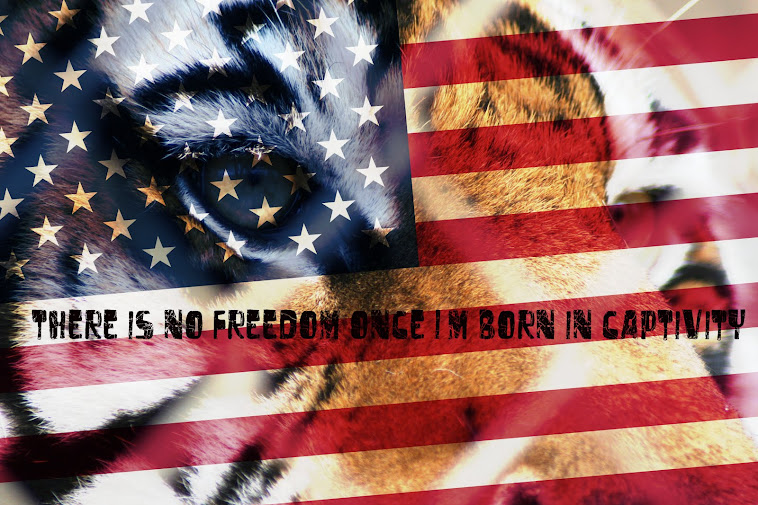
No other country on our planet has so freely allowed the breeding and selling of Wild Animals as pets, or for financial gain, by providing a license for that ownership as does the U. S. Dept. of Agriculture. There is not one thing we can give a wild animal in captivity that they need. What they do need is to be born free, in their natural environment.
Let your representative know you want their support on this bill!
Find your representative at: http://www.house.gov/representatives/find/
Calls to your Rep will make far more difference than just an email, but if you would like
to sign a prewritten letter that will be emailed to your local representative please go to http://capwiz.com/bigcatrescue/issues/alert/?alertid=61054081
Thank you! And please spread the word! The more people are educated the better chance we have of making real change!
Wednesday, February 29, 2012
Big Cats and Public Safety Protection Act
Great news from Capitol hill! A bipartisan act has been proposed that would make it illegal for private citizens to own or keep big cats. Here's a small excerpt from the Examiner to read more please follow the link below. We must support this act folks! Let your representatives know that you would like their support!
The Big Cats and Public Safety Protection Act would prohibit private possession of big cats except at highly-qualified facilities like accredited zoos where they can be properly cared for and restrained. Also, since nobody, including the U.S. Department of Agriculture (USDA), state agencies, and local first responders knows exactly how many dangerous big cats are being kept in private hands, under what conditions, and in what locations, the bill would require any persons who currently possess big cats to register those animals with USDA in order to keep the cats they currently own. The bill would also outlaw the breeding of any big cat except at accredited zoos and research and educational institutions. Violators of the law could have their animals confiscated along with any vehicles or equipment used to aid in their illegal activity, and could face stiff penalties including fines as much as $20,000, and up to five years in jail.
Continue reading on Examiner.com Big Cats and Public Safety Protection Act Introduced - Tampa Bay Cats | Examiner.com http://www.examiner.com/cats-in-tampa-bay/big-cats-and-public-safety-protection-act-introduced#ixzz1noCduGzJ
Friday, February 17, 2012
The Circus
 |
| You are paying money for this, and I'm suffering for it. |
The Circus is one of the great memories in a child's life. I know I remember going and being amazed at the tigers and elephants doing incredible tricks. Now that I am an adult I have had to face the hard fact that the animals I watched with shear amazement when I was a child, were being abused in order that I may be entertained. This sort of abuse still goes on in order that we, as civilized human beings, can be entertained. The wild animals that you see in these circus acts are being trained with unspeakable methods. Elephants are tied and struck with large metal hooks, imagine a giant fireplace iron, in order to teach them the tricks we watch with amazement. Tigers are whipped and starved until they will perform. Can you imagine any animal willingly jumping through a hoop of fire? Do you imagine that elephants stand on their heads in the wild just because they feel like it? How can we call ourselves civilized when we continue to allow such abuse to be continued? Most civilized countries have passed laws that ban the use of wild or exotic animals in the circus. Isn't it about time we do the same? There is a bill before the house HR 3359 that would stop the use of exotic animals in the circus. As a civilized people, we must support this bill. Let your representative know that you no longer wish to see animals in the circus because the abuse they suffer in order to entertain us is wrong. There are many other ways we can expose our children to exotic animals. Take them to an accredited zoo or an accredited animal sanctuary. In these places they can see the animals in a more natural habitat and can learn about the need to keep these animals safe in the wild and what they can do to help. After all, they are the ones who can keep animal conservancy going in the future. But if we don't teach them what is right and what is wrong, then how will they carry on the efforts to protect and conserve animals and their habitats? Please consider before you take your child to a circus what it is you are exposing them to and what you are paying for. Also, please go to www.catlaws.com to find ways to help stop the abuse of these magnificent animals.
 |
| That thing in my back hurts me! |
Below is a link to a video that will give you more insight into what these animals face everyday. Please watch it and pass on your knowledge to everyone you know. Only we can stop the abuse! Thank you.
 |
| Do we look happy to you? |
Thursday, February 9, 2012
Valentine's Day the Leopard way
Here's a little clip of two leopard sisters at Big Cat Rescue playing with their valentine's day enrichment. Enjoy!
http://m.youtube.com/index?desktop_uri=%2F&gl=US#/watch?v=mzKU8nj4M_Y
Monday, February 6, 2012
Greece bans animals in circus
Here's a little bit of good news! Greece has banned animals in the circus! If they can do it so can we! Check out the bill that is before the house HR3359 that would ban the use of exotic animals in the circus in the U.S.
Check out this link to learn more about Greece banning animals in the circus: http://www.ad-international.org/animals_in_entertainment/go.php?id=2528&ssi=10
And check out www.catlaws.com to find out how you can help stop the use of exotic animals in U.S. circuses.
Subscribe to:
Posts (Atom)